 Dennis Donchev
Car odor removal is one of the most requested services in San Diego. You may have already tried a pine tree air freshener, baking soda, fabric spray, or leaving the windows open for a week, but the smell still comes back.
Quick fixes rarely work long-term because they do not treat what is actually causing the odor. They cover them up.
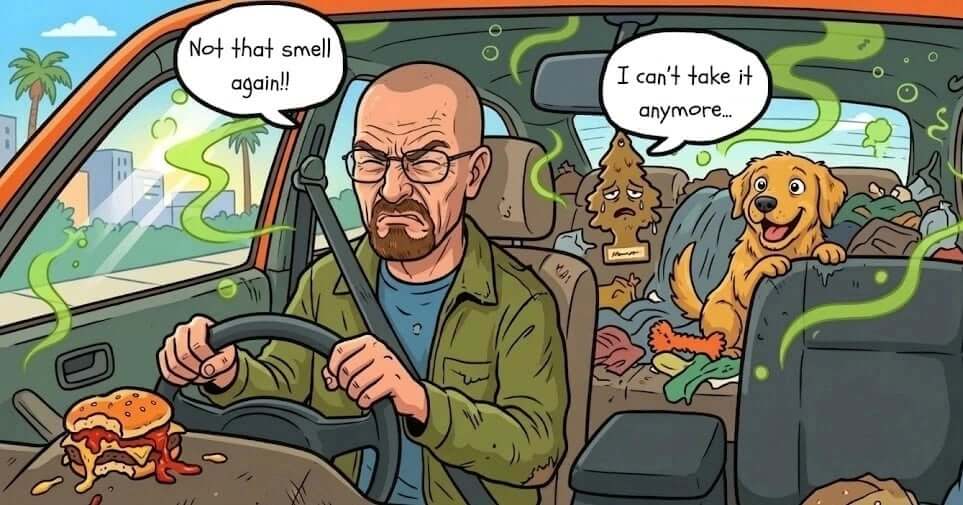
Remember Walter White from Breaking Bad? “I am the danger.” If you’ve been ignoring the smell in your car, here’s the truth: you are the smell. The longer you wait, the deeper it soaks into your seats, carpet, and headliner, and the harder it gets to fix. I’ve been in hundreds of cars, and the number one thing I hear after a detail is, “I wish I’d done this sooner.”
Imagine getting back into your car and smelling absolutely nothing. No dog. No smoke. No three-week-old french fries. Just clean air. That’s what we do.
What’s in this guide
- Why San Diego Cars Smell Worse Than You’d Think
- The 5 Smells We Get Called About Most
- Why Air Fresheners and Febreze Will Always Let You Down
- What Ozone Treatment Actually Does
- Step-by-Step Process
- What It Costs In San Diego
- Signs Your Car Needs Professional Odor Treatment
- Frequently Asked Questions
Why San Diego Cars Smell Worse Than You’d Think
Most people assume a bad car smell means they’re messy, but in San Diego, that’s not always the case.
The weather here is great. Sunny, warm, beach days all year, but that same heat can make odors build up fast inside your car. Once summer kicks in, things get worse quicker than you’d expect.
A small spill, like coffee, might be harmless in a colder place. But in San Diego heat, especially when your car is parked in the sun, interior temps can hit 140–160°F. At that point, it’s basically “baking” the spill into your seats and carpet, pushing the smell deeper into the fabric and foam underneath.
And it’s not just the heat. San Diego has a perfect recipe for stubborn car smells:
- Hot summers
- Coastal humidity
- Beach trips every other day
- Dogs living their best life in your backseat
- And year-round driving with no real “break” for your car
There’s no winter reset here. No freezing cold to pause things. Everything just builds up. So if you’ve left a wet towel, wetsuit, or a very happy dog in the car after the beach, you already know what happens next. You come back the next day, and your car smells like it has its own ecosystem.
The 6 Most Common Car Smells in San Diego
Not every bad car odor is the same, and the way you fix it depends completely on what’s causing it. Here are the five we deal with most in San Diego and what’s actually going on under the surface.
| 🚬 Cigarette & Cannabis Smoke |
|---|
|
Smoke doesn’t just float around. It soaks into everything it touches over time. The ceiling, the vents, the leather, and the foam padding. One of the hardest smells to eliminate without professional treatment. |
| 🐾 Pet Odor |
|---|
|
Dog dander, saliva, and fur oils sink deep into seat cushions over time. Urine is its own category. It soaks all the way through the fabric into the foam underneath. The longer it sits, the deeper it goes. Dry vacuuming alone won’t fix it. |
| 💧 Mildew & Musty Smell |
|---|
|
A wet dog, a damp wetsuit, or a wet towel left in a hot, sealed car is all it takes. In coastal areas like Ocean Beach and Pacific Beach, the marine layer adds extra moisture. Once mold grows inside your HVAC vents, it recirculates through the cabin every time you turn on the AC. |
| 🍔 Food & Drink Spills |
|---|
|
Spilled milk, fast food grease, coffee, or energy drinks that soak into carpet and seat foam ferment in San Diego’s heat and create sour, rancid odors. A quick wipe-down doesn’t get what’s already soaked into the padding underneath the seat. |
| 🤢 Vomit & Bio Waste |
|---|
|
Stomach acid and organic material sink into the foam fast. This is one of the hardest smells to remove on your own, and no DIY fix gets all of it. It happens. Kids, road trips, late nights. We handle it. No questions asked, no judgment whatsoever. |
| 🐱 Mystery Smell |
|---|
|
Sometimes people notice it but can’t quite figure out what it is. It’s not exactly smoke, pets, and food. It’s more like a “used-in” smell that slowly builds up over time. Like the car has simply gone through everyday life without a proper reset. And the good thing is, it’s very fixable. |
Why DIY Methods Always Fail
Here’s the honest truth. Nothing you buy at the store actually removes car odor. It covers them up. And when heat mixes with a masking spray, it can make the smell even worse. Almost everyone tries the home remedies first. We don’t blame you, but you’re not solving anything.
DIY methods and what goes wrong
| What people try | What it actually does | Why it fails | Verdict |
|---|---|---|---|
| Air freshener / Little Tree | Adds a pine scent on top of the smell | Covers the odor for 2–5 days, then it’s back. The source is completely untouched. | Doesn’t fix it |
| Baking soda | Absorbs surface smells | Only works at the very surface. Does nothing for odors already deep in foam or carpet padding. | Barely helps |
| Febreze / fabric spray | Temporarily wraps odor molecules and freshens the surface fabric | Doesn’t remove what’s causing the car odor, so it comes back in 1–3 days. | Doesn’t fix it |
| Charcoal bags | Slowly absorbs mild odors over time | Way too slow for anything serious. Useless against smoke, pet urine, or anything that’s already soaked in. | Not enough |
| Leaving windows open | Ventilates the car | Fresh air is great but it doesn’t reach inside the seat cushions, the carpet backing, or the AC vents. | Temporary at best |
| DIY steam cleaner | Loosens surface grime | Can actually push odors deeper into foam and spread mold if the source hasn’t been treated first. |
Professional treatments and why they work
| What’s done |
Why it works |
|---|---|
| Remove the source first | The cause of the car odor is physically removed before any treatment begins |
| Strong ozone treatment | A powerful machine is used to reach deep areas like seat foam, carpets, and air vents where smells get trapped. |
| Enzyme cleaning | Medical-grade enzyme cleaners break down organic proteins at a molecular level, targeting the source instead of just the surface. |
| AC system cleaning | The car’s air system is turned on during treatment so the cleaning air reaches inside the vents where odors hide and keep coming back. |
| Guaranteed result | The job isn’t finished until the smell is completely gone. |
What Ozone Treatment Actually Does
Ozone (O₃) is just regular oxygen with one extra atom attached. That extra atom is unstable, and it wants to break free. When it does, it attaches to the particles, causing car odor, and destroys them. Then it turns back into clean, regular oxygen. No chemical left behind. No new smell. The car odor is just gone.
Think of it like sending a cleaning crew into every vent, every seat cushion, and every fold of your headliner that a vacuum can never reach. Everywhere air can travel, ozone can travel.
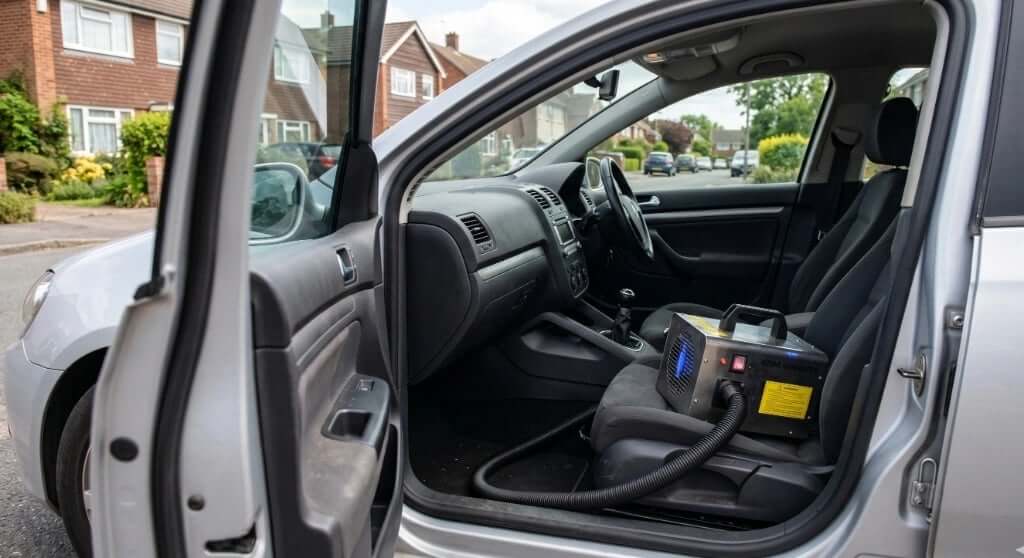
That’s the big difference between ozone and everything else: it’s a gas. It fills your entire car, every gap where a spray bottle or sponge could never fit. It doesn’t mask the car odor. It takes it apart completely.
Simple science behind it. Normal oxygen has two atoms and is stable. Ozone has three, which makes it unstable and wants to release that extra atom. When it comes in contact with odor-causing particles (like smoke or pet smells), it attaches to them and changes their structure so they no longer smell. Once that happens, ozone goes back to normal oxygen, leaving nothing behind.
Ozone vs. enzyme cleaner: Which one does your car need?
These are two different tools that solve different parts of a car odor problem.
| Method | What it does | Best for |
|---|---|---|
| Enzyme cleaner | Specialized enzymes break down organic matter such as urine, vomit and food at the molecular level | Pet accidents, vomit, food spills, and anything with a physical source |
| Ozone treatment | Gas that travels everywhere and destroys odor molecules on contact | Smoke, mildew, cannabis, and general musty odors, HVAC smells |
| Both together | Enzyme takes care of the source, ozone kills what you have floating around | Heavy contamination, pet urine, vomit, heavy smoke, the hard jobs |
Simple rule: If car odor has soaked deep into materials like seat foam, it needs to be treated at the source first using enzyme cleaners. Ozone works afterward to eliminate any remaining odor in the air and hard-to-reach areas.
Step-by-Step Process And What to Expect
A lot of people hesitate to book because they’re not sure what’s going to happen. Here’s how car odor removal typically works from start to finish:
- Assessment
The vehicle is inspected to identify the type of smell, where it’s coming from, and how deep it has gone. This determines the right approach. - Deep cleaning
Seats, carpets, and fabrics are thoroughly vacuumed and extracted to remove as much physical buildup as possible. - Enzyme treatment (if needed)
For odors like urine, vomit, or other organic sources, an enzyme cleaner is applied to break down what’s causing the smell at its source. - Ozone treatment
An ozone machine is placed inside the car, allowing ozone to circulate through the entire interior, reaching vents, cushions, and hidden areas. - Ventilation
After treatment, the car is aired out. Ozone naturally turns back into regular oxygen, leaving no residue or added scent. - Final check
The process is only considered complete once the odor is fully gone.
And the best part? Detailers come to you. You don’t drive anywhere, you don’t sit in a waiting room, and you don’t rearrange your whole morning. We show up at your home or office. La Jolla Mobile Car Detail was built around giving busy people their time back. That’s kind of the whole point.
Signs Your Car Needs Professional Odor Treatment
Sometimes it’s obvious. Sometimes you’ve just been living with a smell so long that you’ve stopped noticing it until someone else gets in the car and their face does the thing.
Here’s a quick checklist. If any of these feel familiar, it’s time to book:
- The smell is worse in the morning when the car has been sitting overnight with the windows closed
- You’ve used three or more air fresheners this month and can still smell whatever it is underneath
- Your Uber rating started dropping and you’re not sure why (San Diego, you know who you are)
- You made an excuse not to pick someone up from the airport because you didn’t want them in your car
- Every time the AC turns on, there’s that first hit of something musty before it settles down
- You just bought a used car and there’s a smell that the seller swore was “almost gone”
- A pet accident, food spill, or vomit happened and it’s been more than a few days
- You’ve tried DIY fixes multiple times and the smell keeps coming back within a week
Ready To Permanently Remove That Smell? Here’s How Easy It Is
Tell us what you’re dealing with, and we’ll let you know exactly what your car needs. No pressure, no guessing. Detailers come to you anywhere in San Diego, and we don’t consider the job done until the smell is gone.
Book Your Car Odor Removal Now
For accidents, spills of the organic kind, or anything a glove box air freshener cannot touch, professional biohazard cleanup is its own specialty.
FAQs
How long does ozone treatment take?
Most cars take 1–3 hours depending on how bad the smell is. A car with light smoke might be done in an hour. A car that’s been smoked in heavily for years could take longer. We’ll give you a straight estimate after we look at the car, no guessing games.
Is ozone treatment safe for leather, fabric, and plastics?
Yes, professional ozone treatment is safe for all standard automotive interior materials, including leather, vinyl, fabric upholstery, carpet, plastics, and rubber. High concentrations of ozone for extended periods can potentially affect certain dyes, so we monitor treatment time and concentration carefully.
My car smells musty every time I turn on the AC. What causes this?
That’s mold or mildew growing inside your evaporator core, the component inside your dashboard that cools the air. In San Diego’s coastal environment, moisture condenses on the evaporator, and if the system doesn’t fully dry out, mold grows. Ozone treatment with the HVAC running is the most effective way to treat this. Some cases may also require an evaporator cleaning spray applied directly into the air intake.
Can you get cigarette smell out of a used car I just bought?
Absolutely! Smoke odor is one of the most common calls we get. It’s very treatable. Heavy, long-term smoke might need more than one session and a cabin air filter swap-out (the filter holds a lot of smoke residue), but we’ll tell you upfront what to expect before we start. No surprises.