
This motorcycle detailing guide starts with what most riders don't realize: that garden hose pressure washer in your driveway can force water directly into your bearings, electrical connections, and air filters. One bike owner on a motorcycle forum described how high-pressure water caused "electrical gremlins to surface" after steam got everywhere during washing. Even Honda's official motorcycle care guide warns that high-pressure water cleaners can damage moving parts and electrical parts, making them inoperable.
You'll learn exactly how to avoid these costly mistakes. Motorcycles aren't just small cars with two wheels. They're exposed machines with complicated parts that need specialized care.
Here in San Diego, bikes face a unique challenge. The salt air rolling in from the Pacific mixed with the intense UV rays from our inland heat creates a constant attack on your bike's finish. Proper motorcycle detailing keeps your machine safe to ride and protects the money you've invested in it.
Table of Contents
- Understanding Your Options: Where to Get Your Bike Cleaned
- The Professional Process: What Goes Into a Deep Detail
- Specialized Protection for the Coastal Rider
- Why Naked Bikes Need Extra Attention Near the Coast
- What's Included in Professional Motorcycle Detailing
- The Economics of Maintenance: Resale Value in San Diego
- Final Thoughts
- FAQs
Understanding Your Options: Where to Get Your Bike Cleaned
Let's go over the choices most riders face when their bike needs cleaning.
The driveway wash the easiest option. You've got a hose, some soap from under the sink, and 30 minutes on a Saturday. But here's what most people don't realize:
Garden hose pressure can force water into bearings, electrical connections, and air filters
Dish soap strips away protective oils on your chain and wax on your paint
You risk damage that looks fine on the surface but causes problems later
Self-service car washes are actually the worst choice for motorcycles, and I wish more riders knew this. According to water treatment specialists at Sensorex, sand and clay particles in recycled wash water can damage vehicle paint, and carwash industry experts note that suspended solids in reused water will damage paint and create poor water quality. The degreasers they use are designed to strip oil off semi-truck engines. When you spray that on your bike's delicate finishes, gaskets, and seals, you're stripping away protective coatings that took the manufacturer years to perfect.
Motorcycle repair shops will sometimes wash your bike after service, but think about what they're focused on. They're mechanics trying to remove oil and grime so they can work on the engine. They're not thinking about preserving your chrome or protecting your resale value. It's an afterthought, not a specialty.
Professional mobile motorcycle detailing services bring something different to your driveway. These are specialists who understand bike-specific metallurgy, use pH-balanced chemicals that won't damage sensitive parts, and bring deionized water that won't leave mineral deposits. It's the difference between someone who washes bikes and someone who understands them.
The Professional Process: What Goes Into a Deep Detail
Real motorcycle detailing starts before anyone touches a sponge to your bike.
Chemical decontamination comes first. There's a product called an iron remover that literally dissolves the brake dust and road salt that's bonded to your metal surfaces. You'll see it turn purple as it works. This step alone prevents scratching during the wash because you're removing the abrasive particles before they get dragged across your paint.
Safe degreasing is where experience with motorcycle detailing really matters. Your chain needs to be cleaned, and so does the engine area. But those rubber gaskets, O-rings, and powder-coated frames? They can be damaged by harsh degreasers. Professional detailers use products that break down oil and grime without attacking the materials that keep your bike sealed and protected.
The hand wash and dry might sound simple, but it's anything but. Ultra-plush microfiber towels prevent scratching. Then comes the critical part: forced air drying. Professional detailers use blowers to remove water from every recessed bolt, cooling fin, and hidden crevice. If water sits in these spots, you get corrosion and water spots that are incredibly hard to remove later.
Metal Polishing and Paint Correction
This is where a dirty bike becomes something special again. Chrome that's been dulled by oxidation gets polished back to that mirror finish you remember from the showroom. Those scratches on your tank from your jacket zipper or riding gear? They can often be reduced or removed completely through careful paint correction.
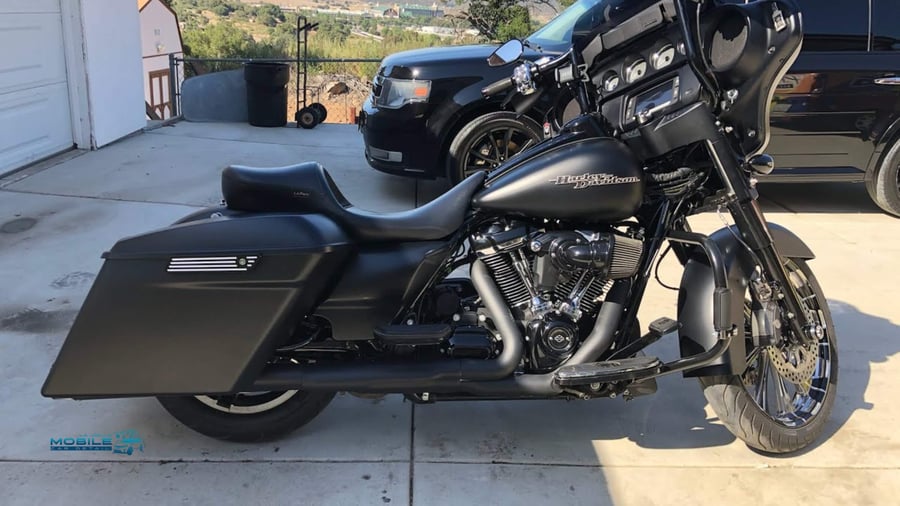
A properly maintained Harley-Davidson showing the results of regular motorcycle detailing—matte black paint protected from coastal elements
I've seen 10-year-old bikes look brand new again after proper metal polishing. It's all about understanding how different metals respond to different compounds and having the patience to do it right.
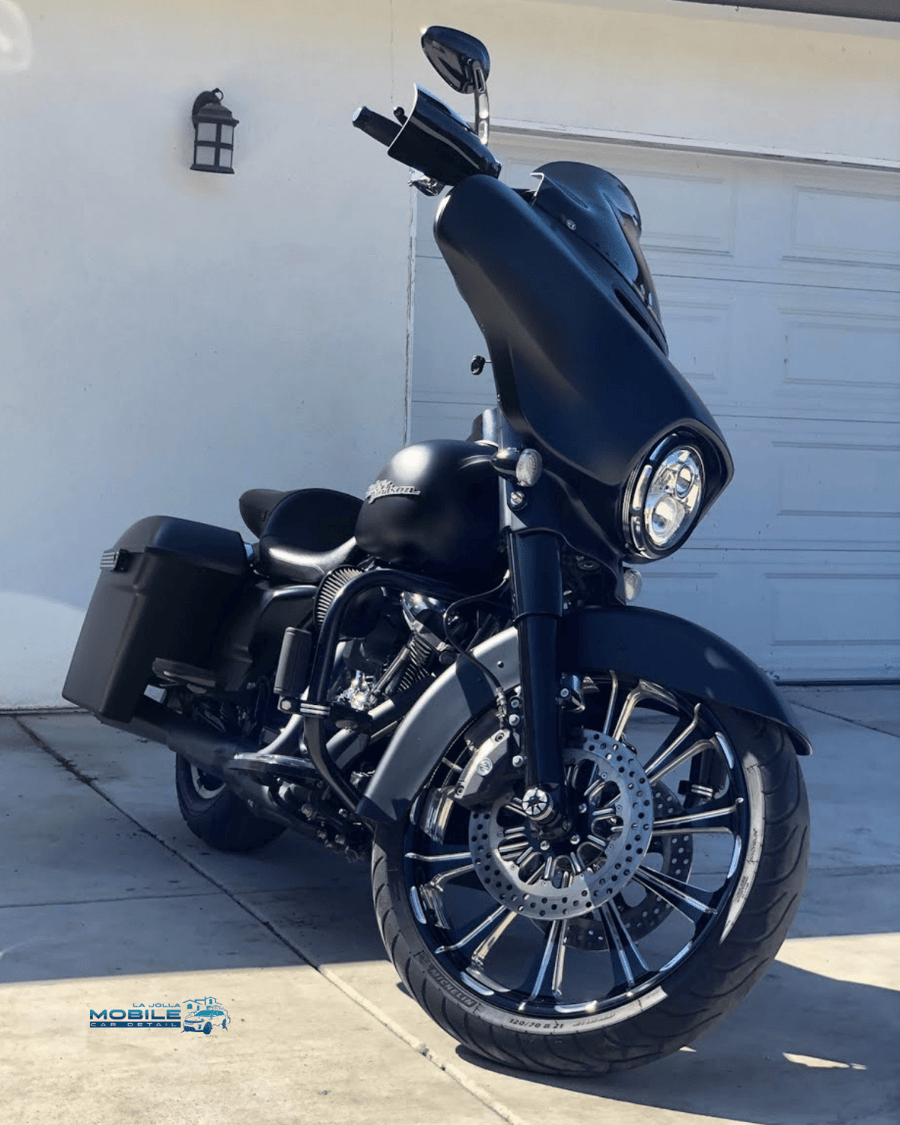 Harley restored to showroom condition through precision motorcycle detailing and paint correction
Specialized Protection for the Coastal Rider
Living near the ocean means you need more than a good wash. You need protection that lasts.
Ceramic coating has changed the game for bikes parked near the coast. This is a chemical bond with your paint that lasts 2 to 5 years. Benefits include:
🛡️ Acts as a permanent rain jacket for your bike's finish
💧 Salt spray beads up and rolls off instead of sitting on the surface
🚫 Prevents salt from eating through the clear coat
✨ Easier cleaning between details
UV shielding matters more than most people think. San Diego sun is intense, and it doesn't just fade your paint. It makes plastics brittle and prone to cracking, turns carbon fiber cloudy and dull, and cracks leather seats over time. The right protection products contain UV inhibitors that absorb those damaging rays before they can break down the materials.
Corrosion inhibitors are molecular-level barriers applied to the undercarriage and engine block. These create a shield between the metal and the salt air that's constantly trying to oxidize everything. This protection works every single day your bike is parked.
Why Naked Bikes Need Extra Attention Near the Coast
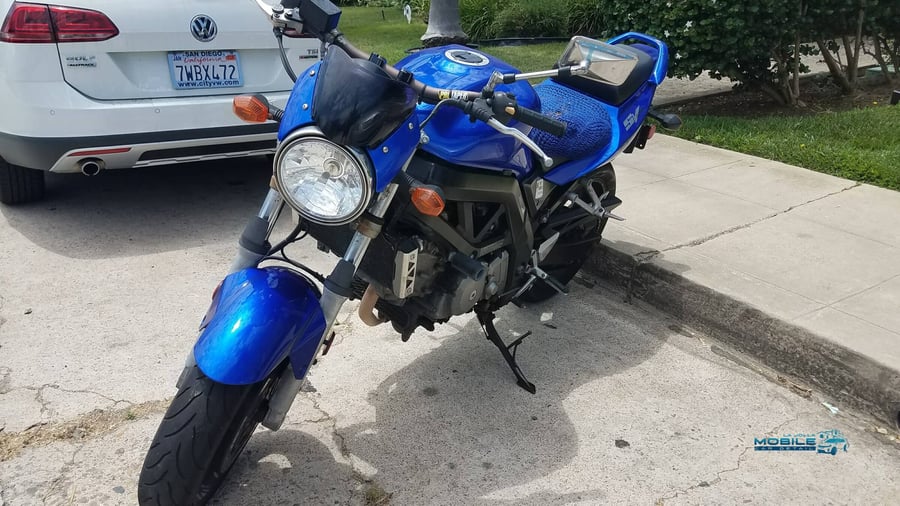 My sweet Suzuki SV650 without motorcycle detailing love, even the seat split open from not getting conditioned
I learned this the hard way with my GS500E, SV650, and Triumph Street Triple 765—all naked bikes. Living in La Jolla blocks from the ocean, I watched salt air attack every exposed surface even with a tarp.
Detailed chrome work and protected finishes—the result of consistent professional care in coastal conditions
Naked bikes have everything exposed. No fairings protecting the engine, frame, or exhaust. I'd find surface rust on bolts, corrosion on radiator fins, and white oxidation on aluminum parts. The Street Triple was worst—so many exposed components taking the full brunt of coastal elements. Bolts turned brown, exhaust headers developed spots constantly.
The lesson? A quality cover helps, but regular motorcycle detailing with corrosion protection is what actually wins. Those ceramic coatings and corrosion inhibitors aren't luxury upgrades for naked bikes near the coast—they're essential.
What's Included in Professional Motorcycle Detailing
A comprehensive motorcycle detailing service includes:
🧪 Chemical decontamination - Removes brake dust and road salt before washing
🧼 Safe degreasing - Cleans chain and engine area without damaging gaskets
💦 Hand washing - pH-balanced products protect your finish
💨 Forced air drying - Prevents water spots in recessed areas
✨ Metal polishing - Restores chrome and aluminum to mirror finish
🛡️ Protective coatings - Seals and protects all surfaces
Additional services might include paint correction to remove scratches, ceramic coating application, and specialized treatments for leather or carbon fiber components.
The Economics of Maintenance: Resale Value in San Diego
Here's something that might surprise you: professional motorcycle detailing isn't just about keeping your bike looking good. It's about protecting your investment.
In the Southern California used motorcycle market, a professionally detailed bike commands a serious premium of $1,000 to $2,000 more than an identical model that's been neglected. Private buyers can see the difference immediately, and they're willing to pay for a bike that's been cared for.
Different brands hold value differently, especially when the cosmetics are maintained. According to motorcycle resale value experts, Harley-Davidson and Ducati motorcycles retain the highest resale value when the paint and chrome are kept in showroom condition. Research from EagleLights indicates that Harley-Davidsons typically retain 60-70% of their original value after 3-5 years, especially Touring and Softail models.
Estimated 5-Year Value Retention (San Diego Market)
| Motorcycle Type | Average Retained Value | The Detailing Advantage |
|---|---|---|
| American Cruisers (Harley-Davidson) | 68% – 72% | Prevents chrome pitting and leather cracking |
| Japanese Sport Bikes (Yamaha, Honda, Kawasaki, Suzuki) | 55% – 60% | Maintains fairing clarity and chain health |
| European Touring/Sport (Ducati, BMW, Triumph) | 62% – 65% | Preserves technical finishes and carbon fiber |
| Adventure/Dual-Sport Bikes | 50% – 55% | Removes trail staining and frame oxidation |
Based on industry research from motorcycle resale value studies, including data from EagleLights, Powersport Buyers, and Zen & Chill market analysis. Individual results vary based on maintenance, mileage, and local market conditions.
Motorcycle Depreciation Timeline: The First 5 Years
Understanding how quickly motorcycles lose value helps you appreciate why regular motorcycle detailing pays for itself over time.
| Year | Average Depreciation Rate | Cumulative Value Loss | What Affects It Most |
|---|---|---|---|
| Year 1 (New) | 20% - 25% | 20% - 25% | Simply driving off the lot, initial wear |
| Year 2 | 10% - 15% | 30% - 40% | Mileage accumulation, new models released |
| Year 3 | 10% - 12% | 40% - 52% | Condition becomes more visible factor |
| Year 4 | 8% - 10% | 48% - 62% | Maintenance history, cosmetic condition |
| Year 5 | 5% - 8% | 53% - 70% | Overall care, documentation of service |
Source: Data compiled from Motorcycle Habit, Auto Approve, and Cycle Trader depreciation studies. Regular detailing and maintenance can significantly slow depreciation rates, especially after year 3.
The Detailing Difference: While you can't stop the first-year hit, proper motorcycle detailing becomes increasingly valuable in years 3-5 when condition becomes the primary factor in resale value. A well-maintained bike with documented care can retain 5-10% more value than the average.
Think about it this way: if you bought a $15,000 Harley and it's worth $10,200 after five years with regular detailing versus $8,500 without it, you've just paid for every detail you ever got and still came out ahead.
Final Thoughts
San Diego's climate is beautiful, but it's tough on motorcycles. Salt air and UV exposure will win eventually if you're not protecting your bike. Regular professional motorcycle detailing isn't an expense—it's insurance against the environment trying to take your bike apart molecule by molecule. Whether you ride daily or just on weekends, keeping your bike properly detailed means it's safer, more valuable, and more enjoyable to own.
If you love your bike and want it looking sharp for the long term, don't wait until the damage is visible. Get ahead of it now with professional motorcycle detailing that's built for coastal conditions.
FAQs
How often should I detail my bike?
If you're riding daily, aim for every three months. Weekend-only riders can get away with once a year. But if you live right on the coast in neighborhoods like La Jolla or Pacific Beach, or park outside regularly, you might want to bump that up.
Can you detail a bike with matte paint?
Absolutely, but it requires specialized products. Matte finishes can't handle regular waxes or polishes because those add shine. Professional detailers use matte-safe cleansers that clean and protect without changing the finish.
How much does professional motorcycle detailing cost?
Professional motorcycle detailing typically ranges from $150 to $300+ depending on the bike's size, condition, and level of service. According to industry standards, most riders spend $200-300 for a full detail that delivers the results they want. At La Jolla Mobile Car Detail, full motorcycle detailing services start at $199. The price varies based on factors like the amount of chrome, bike size (cruisers vs. touring bikes with fairings), and whether you need additional services like paint correction or ceramic coating. Keep in mind that while DIY supplies might cost $50-100, professional detailing saves you 4-8 hours of labor-intensive work and ensures the job is done without risking damage to sensitive components.
How long does a professional motorcycle detail take?
A standard professional motorcycle detailing typically takes 2 to 3 hours depending on the bike's condition and complexity. Sport bikes and well-maintained cruisers are usually on the quicker end, while touring bikes with fairings, bags, and extensive chrome can take closer to 3-4 hours. If you need paint correction or ceramic coating application, plan for additional time. A mobile detailer brings everything needed to your location, so you don't waste time traveling to a shop.